Showing posts with label Nintendo DS. Show all posts

Thursday, November 4

The Future of JRPGs Lies in Handheld Games

I had written a blog a few months ago in which I had expressed my general discontent towards JRPGs over the past decade or so and it was met with pretty good feedback and praise and I want to thank you all for what turned into a really good discussion. Now then, this blog is sort of a companion piece or a rebuttal to my own work if you will. While my general feelings of JRPGs needing to advance still exist somewhat, here in 2010 there seems to have been a revival of sorts that might show good signs for the genre. Good signs provided you have a handheld at least.

You see, this year I’ve spent more time playing my PSP and my DS more than my Wii or PS3 simply because this is the greatest time ever to be a handheld gaming fan. If you’re a gamer who loved the 90s and the SNES/PS1/Saturn era of gaming then you have to be estatic with the amount of games that have been being released for handhelds over the past few years. This year in 2010, was simply the greatest year for handheld RPGs ever and there’s still more to come. This then is my rebuttal as I said. I shall now direct you to some great fantastic RPGs that have come out in just this year alone and encourage any fan to try these games as examples that hey, maybe there is a future for JRPGs at least on the small screen. I will be employing a new game rating system, one that is flawless and you simply cannot argue with. The Dragon Quest slime rating system! 5 slimes equals awesomeness and if you don't buy it I will come to your house and beat you and greedily grab the gold you leave behind.


1. Glory of Heracles

The Story: While it begins with the usual cliché of the main character having amnesia, this is offset by the unique atmosphere of ancient Greece. Believing himself to be the legendary Heracles, he is believed to be immortal and descended from the Gods themselves and along the way meets several characters who also have amnesia. Once again they get embroiled in the epic clash between Zeus and the Gods vs the Titans and the plot is driven from there. Think Clash of the Titans mixed with Final Fantasy and a little God of War sprinkled for good measure and you’ve got it.

Why Should I Play It, Kenola?: Glory of Heracles is like a nice mix of traditional turn based combat and strategy RPG. After placing your characters on a grid, you can select various commands that have you utilize the DS stylus to get maximum performance for attacks and magic spells. This can vary from touching circles in order or drawing the magic incantations yourself. While it does slow combat somewhat it does present a fresh take on what could have been a very boring battle system.

The Verdict: Not the greatest RPG ever, but definitely worth a look see.



2. Lunar-Silver Star Harmony

The Story: Well, being a remake of the original game on Sega CD and Playstation 1, most gamers are familiar with the plot of this game already, but if you don’t know, the main character Alex has dreams of becoming a Dragonmaster to protect the Goddess Althena. After venturing to the cave of the White Dragon and getting his quest he discovers that members of the Vile Tribe who hate Althena have been capturing girls for whatever reason, his girlfriend Luna being among them.

Why Should I Play It, Kenola?: Lunar was my very first RPG ever on the Sega CD and it holds a special place in my heart to this very day. While this version isn’t quite as good as those other ones, it’s got a entirely new prologue that lets you play as the Four Heroes and updated graphics and sound to make it look even better than before. If you’ve never experienced Lunar, now is the time.

The Verdict: If you’ve never experienced Lunar, now is the time. If you’ve already played through it once, you won’t find this one better, but still, it will be a nice trip down memory lane for you.


3. Shin Megami Tensei: Strange Journey

The Story: Set in a unique science fiction setting, you and a team of UN Inspectors are sent to investigate the Schwarzwelt, a gigantic portal deep in the Antarctic. Once inside you’ll discover a portal full of demons at which point you’ll eventually have to come to a decision. Save mankind or destroy it?

Why Should I Play It, Kenola?: Hell, it says “Shin Megami Tensei” on the box, that’s why. Ok, what sets this one apart from the others is the unique setting and characters. For the first time ever for this series, this game doesn’t take place in Japan and uses mostly American characters. The plot is more akin to a sci-fi action movie and feels like something James Cameron would have come up with to accompany the usual classic Shin Megami Tensei gameplay of negotitating with demons and recruiting them to make them for your own. If you’ve never played an SMT game, think of it as Pokemon with a bit more challenge and mature storyline.

The Verdict: SMT fans, you owe it to yourself to play this one. It’s every bit as great as Nocturne in my opinion and will keep you busy for quite some time. New fans to the series, don’t fret, this is a great introduction to the series and prior knowledge of past SMT games is not required. Check it out!


4. Persona 3 Portable

The Story: You are a high school student who recently moved into town with a very special ability. With a gun called an “Evoker” you can bring out our power known as Persona. You and others like you will combat what’s known as the Shadows that prey upon human souls during the Dark Hour, a hidden hour at midnight between one day and the next. Of course during the day you still have to go to school and carry on a social life. Time rests for no one.

Why Should I Play It, Kenola?: Well, anyone who’s played any of the PS2 versions of this game will give you plenty of reason. Fantastic story, great gameplay and a great challenge for one of the best games in the SMT franchise. Anyone who already has played the PS2 games should still check this one out as an all new female storyline complete with new social links to develop as well as many of the improved play mechanics from P4 such as the ability to control all party members show up here.

The Verdict: The best version of Persona 3 there is. Check it out!


5. Valkyria Chronicles 2

The Story: Set 3 years after the original game (or something like that, I dunno), you play as Avan of a Gallian Military Academy who leads a squadron known as Class G. Class G is called to defend Gallia against rebels who do not like this current era of peace, nor the idea that their country has fallen under Darcsen rule. Calling themselves rebels and declaring their intent to take back Gallia, they seek to rekindle the flames of war.

Why Should I Play It, Kenola?: Well, anyone who’s played the original game can see why you should play this one. The same gameplay that made the original so great returns, mixing action game elements with RPG strategy. The ability to command multiple vehicles as well as assign different classes to your troops is a natural expansion upon the original game. Everything is generally improved here and the game boasts some of the best graphics the PSP has to offer.

The Verdict: Even if you’ve never played Valkyria Chronicles 1, this game is still worth checking out as it has a plot that not only caters to fans of the original but is structured in such a way that it’s a standalone story as well. Those looking for an SRPG fix need look no further.


6. Lufia Curse of the Sinstrals ( Oh what, I just reviewed the damn thing don’t judge me! Okay fine I’ll tell you how many slimes it gets!)


7. Dragon Quest IX: Sentinels of the Starry Skies (Yes, you must type the subtitle as well.)

The Story: You are a Celestrian, a guardian angel of sorts who performs good deeds from upon high in the Observatory overlooking the world. The fyggs of the Yggdrasil Tree must come to full bloom before all Celestrians can ascend to the realm of the almighty. In order to accomplish this task, you must venture toward the world below and collect benevolescence or the crystallized gratitude of the humans below.

Why Should I Play It, Kenola?: It’s very simple. This is in my opinion the best Dragon Quest in the series. Your entire party can be created from scratch, from their appearance to their name to what class they areto how many. You can choose to go it solo if for some reason you desire. The options in DQIX are unlimited. Random encounters have mercifully been abolished and enemies can now be seen on the adventure map. New quests and items are available through the online shop and there’s never any real dull moment in the game. It’s the perfect blend of Western and JRPG concepts and not just one of the best RPGs you can play this year, its one of the best JRPGs period.

The Verdict: Buy it if you haven’t done it yet. I told you so and that’s why, don’t argue with me.


So there you have it. There’s 7 great RPGs I’ve played for handhelds this year alone. The future looks bleak on consoles but I’m glad developers are still committed to providing a fun JRPG experience on the go and there's more to come with a new Golden Sun being released for the DS as well. Don’t miss out on this stuff!

Monday, November 1

Curse of the Expectations (Lufia DS review)

Often times when something is remade it feels like a cheap cash in; simply nothing more than a way to make a quick buck and be done with it. Using a popular brand name to sell an otherwise inferior product. Then there are times such as when Neverland remakes Lufia II for the DS in the form of Lufia: Curse of the Sinistrals. While not perfect by any stretch of the imagination, Curse of the Sinistrals at least feels as though some love and effort was put into the project to present a brand new product that keeps the spirit of the original intact.


While they simply could have given the game 3D graphics and slapped the name “Lufia” on the box and been done with it, Neverland instead attempted to present the original story of the game in a new fashion. In fact, “inspired by” Lufia II would be a more apt description of the title. The plot for the most part has been largely left untouched, a few noteworthy tracks from the original game including the beautiful world map music have been retained and the same familiar characters return as well, despite each of them receiving a more updated, contemporary design. Evil beings known as the Sinistrals, hell bent on destroying the world are challenged by a lone hunter named Maxim, who quickly gets destroyed but is later saved by a mysterious woman named Iris who announces him as a chosen one to defeat Gades and save the world. While not the most complicated story ever, the plot is driven by likeable characters such as Lexis the eccentric scientist, Tia the kind, somewhat jealous close friend of Maxim and Selan, a somewhat silent female warrior. There are other characters and personalities you’ll meet along the way and the game interjects enough light heartedness and humor which breathes enough personality and life into what could have been a very stale, clichéd story.


Characters have been given a fresh, new look to supplement the game.


For starters, whereas the original was a traditional turn based RPG, this one is more of an Action game with RPG elements and puzzle solving. Think a cross between Kingdom Hearts and Legend of Zelda and you’ve just about got it. Many of the areas have been trimmed down and the world map has been wiped from existence; instead you just select each area from a menu (The old world map music mercifully was thankfully kept however.) and travel between areas that way. While areas have been condensed in this title new puzzles are made available for you to solve and they are every bit as challenging as the ones from the original game. Like the original game your party will grow to up to six playable characters who not only have a unique combat style, but each has a special ability they must use to solve the various puzzles. Using each character in conjunction with one another, playing to strengths and weaknesses is the key to advancement.


No world map this time. Just press a button and you're there. But the music is still there.


Great Scott, Marty! That guy looks just like me!

But like in an RPG, characters gain levels and experience and can be strengthened through the use of Mystic Stones. Mystic Stones work much like the license board in Final Fantasy XII, placing different shaped blocks on a certain portion of a large grid with space for each character to occupy that will unlock various stat boosts and elemental resistances. While stones can be placed from just about anywhere as long as they connect to one another, it would be more beneficial to actually pay attention to the different type of stones being used to upgrade characters. Upon first glance character differences may seem simply cosmetic or personal preference, but after a few hours you’ll quickly start to realize how each character differs and play as them accordingly, as some characters are better suited for particular enemies than most others. While this game could have easily fell into the trap of “mash the Y button” all day; and for awhile, it does, by the time you get to your first battle with Gades you’ll quickly realize how to utilize knock downs and air combos to attack the opponent and get free hits unopposed. You’ll learn the merits of rolling out of the way and dodging and when to move in for the kill and unleash your special moves, carefully managing your IP meter so you don’t run out. Well, unless you like the Game Over screen that is.


Boss battles are fun and challenging and make use of both screens.

Then again if all of that sounds too challenging for you, the game does show mercy. If you don’t feel like spending the time to properly place your Mystic Stones or do the dreaded “grind for money and equipment” that takes place in most RPGs, the game allows you to restart 5 levels higher than you were when you died. While there is no real penalty for this, it does significantly remove most of the challenge of the game and simple button mashing will be all that is required to see it to the end. Still, not a bad option for casual players and those wanting to enjoy the story.


All in all Curse of the Sinistrals is a fairly competent reboot of the game despite it’s shortcomings. No, it isn’t perfect. The voice-overs are spotty. Many areas are too small, some expansion would have been preferred. Some animations are a bit lousy, particularly ones where you’re knocked off of your feet; camera angles cannot be adjusted making for a few hard to place jumps and while you can dodge, you cannot block, which can lead to some truly frustrating battles as dodging doesn’t seem to work quite as well as it should. All the same, with an open mind any fan of the original will have plenty to like about this updated version as well as anyone who is new to the series and just wants to play a fun Action RPG on the go. This game is best suited for those who enjoy fast paced combat and puzzle solving. If a more traditional RPG game with exploration and hours of character building is more what you’re looking for from your DS, seek it elsewhere. Stick with Dragon Quest IX or Shin Megami Tensei Strange Journey for your fix.

Thumbs in the middle.

Monday, November 30

Castlevania: Order of Ecclesia Review

After all this talk about vampires, I figured I should post this review that I had already typed up well over a month ago. I planned to post it back during Halloween time, but that nasty little thing called real life got in the way. It's honestly amazing how despite my utter lack of a healthy social life that I harbor, I still have trouble finding free time to work on this blog. It really is.


It's often been said, "You can never have too much of a good thing", but sadly, that doesn't apply when playing Castlevania: Order of Ecclesia. Really though, it's not Order of Ecclesia's fault, either. Unfortunately, we've all been so spoiled by excellent Castlevania games leading up to this point that OOE just seems like a fairly pedestrian retread of the same old concepts we've been accustomed to since Symphony of the Night.

Poor Order of Ecclesia.

Although this game does have enough to make it stand out. For starters, you play as a female, only done once before in a Castlevania game, named Shanoa. Set in the early 1800s, Shanoa's task as a member of Ecclesia, a group dedicated to the eradication of Dracula, is to recover the stolen pieces of Dominus from fellow Ecclesia member Albus, who seeks to use the Dominus to resurrect who else...Dracula. Along the way you'll learn both the purpose behind Albus' plot and the mystery behind Shanoa's dark past as well. The story, while fairly simple, works well enough to keep you entertained, and Shanoa's mysterious behavior and back story are enough to keep the player interested and there's just enough plot twists timed at the proper moment to hold that interest. The story doesn't particularly impress, it's just that many other Castlevania games have plots that follow the same formula. Some evil guy gets something with which to revive Dracula and the main character must stop said bad guy from reviving him, eventually revealing their tie to the whole plot and discovering something about themselves that they either forgot, or didn't realize altogether. Sound familiar? It's the basic outline for every Castlevania game since Symphony of the Night. As a result, most players will feel a grand disconnect despite the game not having any glaring flaws in its narrative.


Poor Order of Ecclesia.

The game itself does absolutely nothing wrong in the gameplay department either. From a design standpoint, the game is arguably the most refined out of any of the Castlevanias on the DS. The weapon leveling system from Portrait of Ruin and the Soul System have been combined into one to form the Glyph system used in OOE. In a change of pace, the need to equip weapons has been completely excised in favor of equipping these glyphs. Glyphs have many different uses and purposes. Some glyphs are swords for stabbing and piercing attacks, some glyphs are hammers for slow, powerful attacks, etc. You can equip one of these glyphs on each hand and by alternating between both the X and Y buttons; you can attack quickly in succession. You can keep this up for as long as your stamina meter allows. Pressing both X and Y at the same time will yield a special attack that consumes hearts. The attack varies depending on which combination of weapons you have equipped. Glyphs purposes don't stop there though. Some Glyphs are also magic glyphs that allow you to perform various magic spells. Some allow you to emit lightning from your fingertips; some recover your health slowly. There's a gamut of possible uses and combinations with the glyphs for you to experiment with. Much like the Soul System, most glyphs can be obtained by defeating enemies. Other, more important ones that the game requires you to obtain can be found in specific areas. You'll definitely need to experiment with all different possible combinations in order to enjoy success with the game, particularly when it comes to the bosses. The game boasts some very interesting and challenging boss encounters that force the player to think rather than swing their weapon over and over until all their health his depleted. Many boss fights will have you stumped in learning the proper strategy on how to defeat them. It may seem frustrating at first, but it's an ultimately rewarding experience when you do figure it out. The game's innovations don't stop with the battle system either; most of the game takes place outside of Castlevania, and similar to Simon's Quest, there's a village that serves as a central hub, where assisting some of the townsfolk will net you various items and information to aid you in your quest. Unlike Simon's Quest however, the game's different areas are connected together via a world map where you just select where you want to go and you're instantly transported there rather than having to trudge through interconnecting areas to progress. Exploring existing locations will eventually open up new areas and getting the proper items or glyphs will allow you to return to an area previously explored and open up a new path that wasn't there before. Sound familiar? That's because it is. Ultimately, the game, despite its little nuances, is exactly the same kind of Castlevania game they've been making for over 10 years now. Koji Igarashi has gone to this particular well many times and Order of Ecclesia may have just drained it of every last drop. The game does everything well. It's a perfect refinement of the formula we've come to expect from Castlevania now. Ayami Kojima returns after being absent for the first two DS games to design some absolutely stunning and gorgeous characters and locations. Michiru Yamane returns to score a fabulous soundtrack. The piece, "An Empty Tome" takes its place among the all time Castlevania themes. However, throughout the entire game experience, right up until the credits roll, in the back of your mind you can't help but feel and overpowering sense of sheer apathy towards the whole thing, despite the fact that you just played a great game. You can't shake the feeling that no matter how great of an experience it is that you've already experienced greatness that is similar or equal to this before. It's the same problem that a franchise such as The Legend of Zelda currently faces. Each subsequent experience is less intriguing or engaging than the last. Not because of any faults within it's design, particularly, but rather because of the company it keeps.


Poor Order of Ecclesia.

Sad, but true. Order of Ecclesia's main problem is that well, it exists. It's not the game's fault that it's simply another Symphony of the Night offspring in a family that has grown too large. Hopefully, the game will be seen as the end of an era. This game will hopefully represent for the SOTN era of Castlevania games that Rondo of Blood did for the originals. Order of Ecclesia could be, and really, should be, the proper send off to the Symphony of the Night style of Castlevania. I'm not saying that the series is dying or that no future Castlevania games need to be made, but rather I'm issuing advice towards its creators. Guys, take heed of the lessons from franchises like Mega Man.; that sometimes, too much of a good thing and lead to just too much of something, period. It's obvious that the series, and indeed Koji Igarashi himself may have burned themselves out by making so many games in such a short time frame. That being said, I still encourage all to check out Order of Ecclesia if they haven't yet done so, as it's a really fantastic game that has a sad, unfortunate fate of being bundled with equally excellent brethren and that’s what keeps it from being classified as simply good, rather than truly great.

Poor Order of Ecclesia.

Saturday, August 8

Shin Megami Tensei: Devil Survivor Review

What? A game review he does? What is this world coming to? Actually, I've got plenty in the can just haven't posted them yet. I plan to rectify that oversight in the next coming weeks. Anyway, as if you couldn't tell by my layout, I'm a pretty big fan of the MegaTen games. No way am I gonna let this one slip through my fingers unreviewed.

If you’re a fan of strategy RPGs or the Shin Megami Tensei line of games, then Devil Survivor is a game that absolutely cannot be missed. It’s one of the best offerings the Nintendo DS has to offer. With its modern day setting, unique rock soundtrack and gameplay that is both fun and challenging, this game breathes fresh life into what can often become a fairly stagnant genre and immediately hooks you in.

The premise of Devil Survivor is simple. In traditional SMT fashion, you play as a nameless main character that has come to visit your cousin, a talented computer programmer in Tokyo. After you and your friends arrive to meet up with him, he’s mysteriously disappeared and soon all of Tokyo is on lockdown, where no one can get in, or out. Food is scarce and all power is out in the city, hence the word “survivor” in the title. Luckily, your cousin left small portable computer devices known as COMPs for short (and strangely also happen to resemble DS Lite’s, hmmm…..) to be able to communicate. Unfortunately, demons begin pouring out of the COMPs and you come to find that you aren’t the only ones with this ability to summon demons as many others who plan to use the demons for harm instead of good exist as well, hence the government lockdown. Your initial task is to stop those individuals and discover the mystery of the lockdown eventually revealing a much larger purpose. The plot is revealed at the player’s pace as storyline events are marked on the map and various branches and alternative paths are opened up depending on where you go, who you visit and what time you visit them. Your actions could even change who potentially joins your party, which makes for great replay value.


I wonder if COMPs have useless Pictochats as well?


This game at its core plays like a typical strategy RPG much like a Final Fantasy Tactics or Disgaea, for those familiar with those games, while combining elements from various other more popular MegaTen franchises like Persona or Digital Devil Saga. Even though this game is part of the “Shin Megami Tensei” line, this story takes place all in its own universe and is pretty much a stand alone story outside of technical terms like spell names and the like. While prior knowledge of previous SMT games is not a requirement, not knowing that “Zio” means “thunder” or that “Agi” means “fire” could initially confuse some casual players, rest assured that the game spends quite a few hours walking any newcomers through a few battles and making sure that you get the gist of it before deciding to just throw you out there.

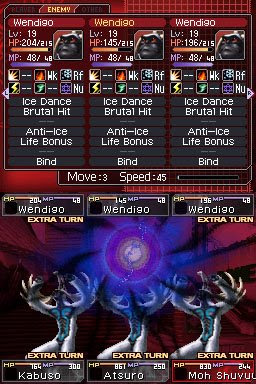
But boy, once you get out there, this game throws you to the wolves. This game starts out fairly simple, but is no cakewalk by any means. By the time you get to your first boss, if you don’t have the basic mechanics down you’ll get creamed. Unlike many other SRPGs, character building is done less with levels than with what skills you know, and equipment like armor or accessories is nonexistent. Instead, much like Pokemon or some other monster raising game, you must find and train new demons in order to, ahem, survive. This is done via a Demon Auction where you must bid cash in order to get the demon that you want. Other people may offer a better price so there’s no guarantee you’ll get the one that you want unless you buy it at the initial Hammer Price which is usually pretty steep. Your party consists of your main characters who each lead a team of demons. Each team consists of a human storyline character with the ability to control at least 2 demons on the field at once. It takes a turn, but you can recall a demon and switch them out from a stock of up to 24 that you can carry in all. Effectively swapping out your demons and using the right ones for the right situations is the key to success. Positioning on the battlefield is not as crucial as it is in many other SRPGs, you engage the enemy in a battle screen and not in the field so what direction from which you approach the enemy is a nonfactor. You can even heal HP or status effects even when not engaged with the enemy. However, proper exploitation of the battle system is extremely crucial. What demons you have in your stock can either make a battle excessively aggravating or a breeze. The Press Turn system that originated in SMT Nocturne and now seemingly a staple of SMT games once again makes its return here where if your opponent has a weakness and you exploit it, you gain an extra turn that you can use to either cause more damage or heal a dying ally. Likewise, your enemies have this ability as well, so paying attention to subtle details like that is a must. The game does a pretty good job with overlaying all of these statistics however, using the top screen to display each characters statistics and a simple press of the R button switches from allies to enemies.


Many SRPGs fall into the trap of letting you use the basic strategy of letting the enemy come to you, but Devil Survivor, particularly for its major storyline battles doesn’t let you off so easily. Many times, innocent civilians caught in a battle must be saved and the enemy will often times chase after them with ruthless efficiency, other times a powerful boss character will continue to summon demons to do his bidding until he himself is defeated. The player also has the option in combat to consider taking out the leader and thus eliminating the entire unit or instead choosing to eliminate his teammates first which lowers the leaders defense and keeps any teammates from shielding the leader and taking the blow for him, doing so also nets more experience. Finding the proper balance of the two and considering which option is best, particularly in the battles where simply putting the enemy to rout isn’t enough for victory, keeps battles entertaining.

As expected with this being an SRPG, this game requires a lot of time and commitment on your part as it can take quite a few replays of particularly some of the more unorthodox battles to figure out how best to set up your team. The game developers realize this fact and there is always a “free” battle for you to test out various demon combinations and skills in order to get the proper balance that you need. Any battle that will potentially advance the story is marked specifically so you don’t accidentally stumble onto a battle you weren’t prepared for. Unless you’re a SRPG or SMT veteran, you’ll often find yourself spending several hours in between storyline battles grinding and while it can get a little repetitive, discovering new skills and fusing, new and more powerful demons becomes incredibly satisfying and helps to alleviate the usual boredom that often associates grinding in SRPGs.

Of course, this game isn’t perfect. The soundtrack, while decent to listen to perhaps once or twice, has very little varying tracks and often times many of the more particularly repetitive ones can try your patience once you’ve heard them for the 100th time. Also, the difficulty often has a tendency to spike rather than steadily increase, again, forcing lengthy training/grinding sessions for most players, but all the same this game is well worth the time invested and serves as a great introduction to those not familiar with the SMT franchise as well as satiating already established fans.


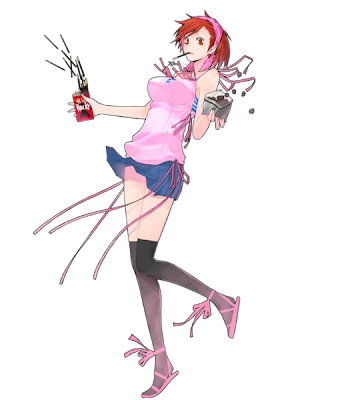
Hmm, a busty Japanese girl with a ridiculously short skirt and loves Pocky? A Japanophile's wet dream.